
How to Stay Flexible and Regain Control Through Unexpected Changes
In moments of change you can find yourself grasping for ways to stay flexible and regain control. When you can’t seem to adjust fast enough, the reality of shutdown and failure feel all too close. And life usually doesn’t give us time to adapt to one difficult situation before another one shows up.
Humans are wired to seek stability, both biologically and psychologically, so when a sudden shift occurs it triggers strong responses. It’s in your nature to fight for stable ground and when you can be more flexible that fight is not as hard.
The Basics That Let You Stay Flexible and Regain Control
Consider this list of basics as a way to evaluate your readiness for life’s surprises. The idea is not to be indecisive but to have a clear mindset of how to approach changes effectively.
Since each of us process information differently and have various capacities for handling stress, take this list as a series of suggestions. Read through and explore a few concepts for yourself until you find what works best for you.

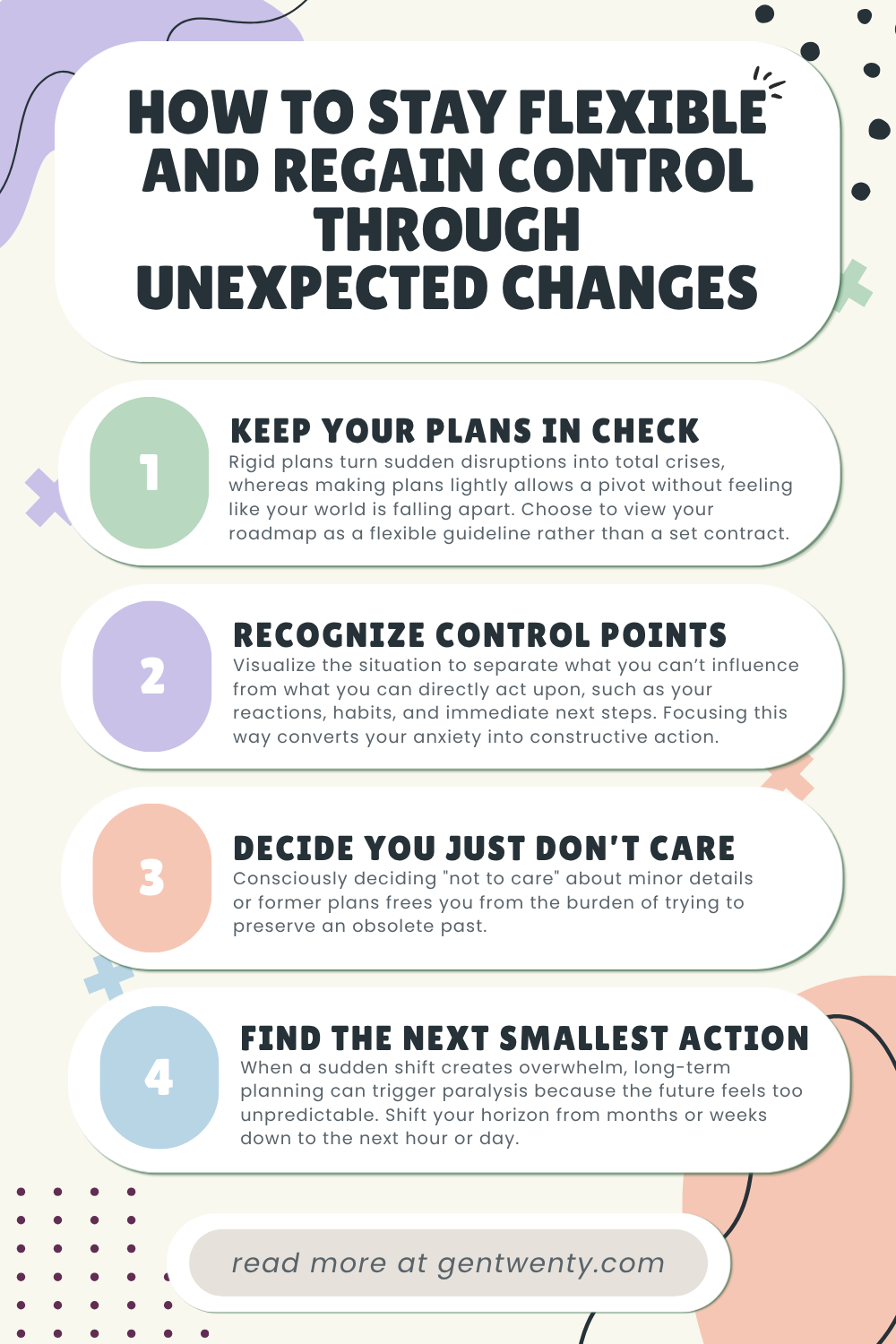
1) Keep Your Plans in Check
Rigid plans turn sudden disruptions into total crises, whereas making plans lightly allows a pivot without feeling like your world is falling apart. Choose to view your roadmap as a flexible guideline rather than a set contract.
When you create a short or long term plan like this you preserve your mental energy for adapting to reality instead of fighting it. This shift in perspective ensures that when circumstances change, your progress doesn't have to stop—it can just change direction.
2) Question Significance
In the heat of a sudden shift, your brain tends to catastrophize and treat every roadblock as an existential threat. Taking a step back to question the significance of this moment is key for regaining control.
Ask yourself how much this moment will truly matter in six months or five years. This analytical approach lowers the emotional stakes and restores perspective. Regaining this big-picture clarity stops panic in its tracks, freeing up your cognitive bandwidth to go with the flow more easily.
3) Recognize Control Points
When life flips upside down, trying to manage variables outside your power only leads to helplessness and exhaustion. Instead of spinning further out of a sense of control, turn your mindset to what is in your control.
Visualize the situation to separate what you can’t influence from what you can directly act upon, such as your reactions, habits, and immediate next steps. Focusing only on your true sphere of control instantly converts your anxiety into constructive action.
4) Evaluate The Energy Worthiness
Your mental and physical capacity is finite, especially during high-stress transitions when cognitive load is already high. Evaluating whether a specific frustration or battle is actually worth your limited energy prevents you from burning out on unproductive struggles.
Look at a situation and consider if the result is worth the effort. Choosing to conserve your energy for high-impact actions keeps you grounded and effectively in charge of recovering.

5) Consider Alternatives to Stay Flexible and Regain Control
Unexpected change often feels like a dead end simply because your original path was blocked. In line with keeping your plans in check, your flexibility relies on recognizing that multiple routes can lead to a fulfilling outcome.
Actively brainstorming Plan B, C, or D breaks the paralysis of binary thinking and restores a sense of agency. Knowing you have viable alternative options turns a dead end into an intentional new approach.
6) Meet Yourself with Grace
Navigating disruption is inherently messy. On top of that, demanding immediate perfection or instant recovery from yourself only amplifies the stress.
Practicing self-compassion allows you to acknowledge fear, grief, or frustration without letting self-criticism take hold. By accepting that adaptation is a gradual and often difficult process, you build the emotional safety needed to keep taking steps forward.
7) Foster a Growth Mindset
A growth mindset considers unexpected shifts not as personal failures or unfair punishments. Instead it places you on an intense training ground for new skills and wisdom.
When you view obstacles through the lens of curiosity and learning, the discomfort of change becomes far less intimidating. Your transformation in attitude turns the unpredictable into raw material for personal development.
8) Decide You Don’t Care to Stay Flexible and Regain Control
Regaining control often requires intentionally letting go of external expectations, social pressure, or outcomes that no longer serve you. Consciously deciding "not to care" about minor details or former plans frees you from the burden of trying to preserve an obsolete past.
This might seem like a ruthless, and for some of us impossible, choice to make. But, unburdening yourself from unnecessary attachments unleashes the clarity and radical flexibility needed to embrace what comes next.

9) Find the Next Smallest Action
When a sudden shift creates overwhelm, long-term planning can trigger paralysis because the future feels too unpredictable. Shift your horizon from months or weeks down to the next hour or day.
Now ask, "What is the single smallest constructive thing I can do right now?" Executing a tiny, manageable step—like sending one email, making a meal, or organizing your desk—reclaims momentum and proves to your brain that you are still in the driver's seat.
Practicing For Unexpected Changes
Although we can’t prepare for everything life will throw at us there are ways we can “practice” flexibility. Making intentional choices to experiment with your ability to adjust means your mind and also body is better equipped when the unexpected does happen.
1) Build A Baseline Routine
This type of routine will be a very basic part of what you can make happen each day. Choose something simple in your routine like morning stretches, a consistent sleep schedule, or a daily walk.
Small, reliable touchpoints signal safety to your nervous system and provide a stable foundation from which to handle chaos. Even when everything might feel out of control there will still be this one non-negotiable point of control for you.
2) Choose The Different Option
Practice adaptability in small moments that happen daily so it becomes second nature during major shifts. Take a different route home, try new foods, or swap up your weekend routine.
Doing this with minor, safe situations trains your brain to stop treating novelty or disruption as an automatic threat. So, when major, unexpected shifts occur, your mind is already accustomed to adjusting on the fly.
3) Explore Variety to Stay Flexible and Regain Control
Having diverse sources of fulfillment can act as a natural buffer against surprising changes in life. Think of ways you can spread your sense of purpose across career, relationships, creative pursuits, health, and hobbies.
As life’s changes catch you off guard you will be less likely to feel lost or confused. There will be a variety of options for tapping into your sense of identity and purpose if one of them becomes disrupted.

4) Scenario Mapping
Instead of locking yourself into a single, rigid plan, map out a primary path alongside two back-up options (Plan A, B, and C) for key goals. Knowing you have alternative routes made beforehand drastically reduces panic if things don’t go the way you expected.
These alternatives can shift your mental state out of crisis management. That feeling of spinning out of control is now resolved by simply executing a different pre-considered strategy.
5) The "Nice-to-Have" vs. "Must-Have"
During moments of upheaval, take your immediate goals down to their core intent. Separate essential non-negotiables from flexible preferences.
For example, if your goal to exercise for an hour doesn’t work out, preserve the "must-have" (moving your body) by doing a ten-minute walk instead of abandoning it entirely. In this way your underlying intention stays intact and keeps your momentum alive without causing burnout.
6) Use a Sphere of Influence Map to Stay Flexible and Regain Control
Draw two circles on a piece of paper—one large circle, and then a medium circle in the middle of that large one. Label the inner circle "Within My Control" and the outer circle "Outside My Control."
Dump all your current worries onto the page, placing factors like other people's actions or market shifts outside, and your daily habits, boundaries, and immediate decisions inside. Visually isolating the inner circle immediately halts spiraling. You now have a visual showing you exactly where your energy will yield actual results.
7) The Information Diet
In times of crisis, your instinct is often to compulsively consume news, scroll social media, or ask everyone for advice to feel informed. Unfortunately this actually heightens anxiety and dilutes your sense of agency.
Regain control by setting strict boundaries around what information you let in, when you check it, and whose opinions you consult. Intentionally filtering your inputs protects your mental bandwidth so you can make decisions from a place of clarity rather than panic.

Final Thoughts on How to Stay Flexible and Regain Control
In the nightmare of unexpected changes, your progress will be determined by your flexibility and ability to adapt. Successfully navigating these difficult shifts comes down to training your mind for adaptability and responding in effective ways.
This can feel like an impossible goal for some of us but it is more attainable than you think. By practicing proactive strategies—such as mapping out alternative scenarios, setting boundaries around your energy, and focusing strictly on what you can influence—you build a strong foundation against any crisis.
Embracing flexibility doesn’t mean surrendering your goals, but rather changing how you reach them while showing yourself grace along the way. When unexpected disruptions arise, you can pivot with confidence and maintain control over your path forward.

About the Author

Anna is a twenty-something living in the south. She's passionate about family, crafting, and continuing her education beyond her college degree.