
How Long Does It Take to Rebuild Credit? A Realistic Timeline
If you've ever Googled how long it takes to rebuild credit, you've probably run into two kinds of answers. Either vague reassurances that "it takes time!" or wildly optimistic promises that you can fix your credit in 30 days. Neither of those is actually helpful.
The honest answer is that rebuilding credit doesn't happen on a fixed schedule. It depends on what damaged your credit in the first place, how severe the damage was, and how consistently you build positive habits from here. What I can give you is a realistic framework. This framework tells you what to actually expect at different stages, and what moves the needle fastest.
Because here's the thing: the time is going to pass anyway. Whether you start working on your credit today or put it off for another year, those months are going by regardless. Starting now just means you're further along when they do.

First: What Are We Actually Recovering From When Rebuilding Credit?
Before we talk timelines, it's important to understand that "rebuilding credit" isn't one situation — it's many. The path back from a couple of missed payments looks very different from the path back from a bankruptcy or foreclosure. So let's break down the most common scenarios and how long each typically takes to recover from.
Missed or Late Payments
A single missed payment can drop your score significantly, especially if you had a strong score before. The good news is that this is also one of the faster things to recover from. It typically takes somewhere between 6 and 18 months of consistent on-time payments afterward. This is depending on how late the payment was and whether it was a one-time event or part of a pattern.
The late payment itself will stay on your credit report for up to seven years from the original delinquency date. But here's something that often surprises people: the presence of a negative item on your report and the impact it has on your score are two different things. A late payment from five years ago affects your score much less than one from five months ago. Age matters.
High Credit Utilization Makes it Hard to Rebuild Credit
This one is actually the fastest to fix — and that's genuinely good news. If what's dragging your score down is a high utilization ratio (meaning you're using a large percentage of your available credit), paying down those balances can produce noticeable score improvement within one to two billing cycles.
This is because utilization is calculated based on your current balance, not your historical behavior. Bring that balance down, and your score responds relatively quickly.
This is worth knowing if you have a specific goal in mind because it's the lever you can pull fastest. This makes goals like buying a car or applying for an apartment even easier.
Collections and Charge-Offs
These take longer. A collection account or charge-off can stay on your credit report for up to seven years from the original delinquency date.
That doesn't mean your score is stuck in the same place for seven years. This is because consistent positive behavior in the meantime will gradually outweigh the negative mark. But you should expect this kind of damage to affect you for a few years, even when doing everything right to rebuild credit.
One important thing to know: paying off a collection account does not remove it from your credit report or restart the reporting clock. What it does is change the status from "unpaid" to "paid," which can be viewed more favorably by some lenders. However, the account still stays on your report for the remainder of the original seven-year window.

Bankruptcy
Bankruptcy is the longest road. A Chapter 7 bankruptcy stays on your credit report for ten years from the filing date. A Chapter 13 stays for seven years. Those timelines can feel daunting, but I want to be clear: your score does not stay in the basement for that entire period if you're actively building positive credit history in the meantime.
Many people who've filed for bankruptcy see meaningful score improvement. And, this can happen within two to three years by being consistent with new credit habits. The bankruptcy doesn't disappear, but its weight diminishes as newer, positive information accumulates.
A General Rebuilding Credit Timeline
Everyone's situation is different, but here's a rough roadmap for what progress can look like when you're being consistent:
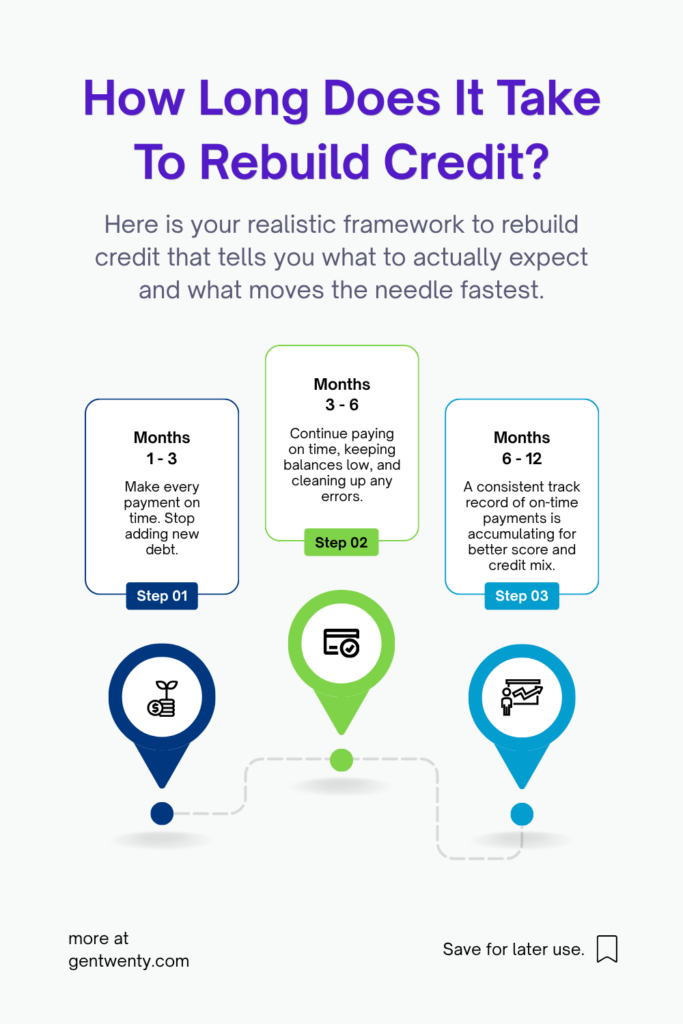
Months 1–3: Stop the bleeding and build the foundation
This phase is less about seeing score increases and more about putting the right habits in place. Make every payment on time. Stop adding new debt.
Pull your credit report and go through it line by line — errors and inaccurate items are more common than people realize, and disputing them can sometimes produce faster improvement than anything else you do. (You can get your free report at annualcreditreport.com.)
Months 3–6: Early movement
If you've been paying on time, keeping balances low, and cleaning up any errors, this is often when you start to see the first real shifts in your score. It may be modest — 10, 20, 30 points — but it's meaningful. It confirms that what you're doing is working.
Months 6–12: Building momentum to rebuild credit
By this point, you're establishing a pattern that credit scoring models can start to recognize. A consistent track record of on-time payments is accumulating. If you didn't have much positive credit history before, a secured credit card or credit-builder loan opened in those early months is now several months old, contributing to both your payment history and your credit mix.

Years 1–2: Recovering from moderate damage
For people dealing with late payments, high utilization, or a few collections, this is typically the range where significant, lasting improvement happens. With consistent habits, scores that were in the 500s or low 600s can often climb into the mid-600s or even 700s. Lenders start viewing you differently. You may qualify for better interest rates than you could before.
Years 3–7: Recovering from serious damage
For bankruptcies, foreclosures, and multiple serious derogatory items, meaningful recovery often happens in this window — not because the items disappear, but because they age. The further in your past they are, the less weight they carry. And if you've spent those years building good habits, the positive history increasingly tells a different story than the old negative one does.
What Actually Speeds Up Rebuilding Credit
Time is a factor you can't control. But there are things within your control that meaningfully affect how quickly you recover:
Pay on time, every time.
Payment history is the single largest factor in your FICO® Score, accounting for 35% of the calculation. Nothing moves the needle more consistently than this. Set up autopay if you need to — there is no shame in using every tool available to protect your score.
Get your utilization down.
Keeping your credit utilization below 30% is the standard advice, but the lower the better. If you can get it under 10%, even better. This is one of the fastest-responding factors in your score.
Don't close old accounts.
The length of your credit history matters, and closing an older account can hurt your score by shortening that history and also reducing your available credit (which raises your utilization ratio). Unless there's a compelling reason, leave old accounts open.
Check your credit report for errors.
I cannot say this enough. Errors on credit reports are not rare — and an inaccurate negative item can be disputed and removed, which can produce faster improvement than almost anything else. You have the right to a fair and accurate credit report. Use it.

Be strategic about new credit so you can rebuild credit
Opening new accounts adds hard inquiries and lowers the average age of your credit, both of which can temporarily affect your score. Be intentional about when and why you're applying for new credit, especially while you're in active rebuilding mode.
The One Thing Nobody Wants to Hear About Rebuilding Credit
Rebuilding credit requires patience. Not blind waiting — active, consistent patience, where you're doing the right things and trusting the process even when the score isn't moving as fast as you'd like.
There will be months where you do everything right and your score barely budges. There will be months where it moves more than you expected. Credit scores are not a perfect real-time reflection of your behavior. Rather they're a lagging indicator, built to reward patterns over time.
What I can tell you from experience is that it's worth it. Your credit score touches more of your daily life than most people realize. This includes your interest rates, your housing options, sometimes even your employment. The effort you put in now will pay off in real, tangible ways down the road.
Start where you are. Do the next right thing. And if you find errors or unfair negative items on your report, don't hesitate to reach out to a credit repair professional who can advocate on your behalf. Sometimes having someone in your corner who knows the system makes all the difference.
About the Author

Nicole Booz is the founder and Editor-in-Chief of GenTwenty and GenThirty. She has a Bachelor of Science in Psychology and is the author of The Kidult Handbook (Simon & Schuster May 2018). She's currently kicking it in Pennsylvania with her husband and three sons. When she’s not reading or writing, you'll likely find her luxuriating over brunch, perusing a thrift store or planning her next Disney trip.
Website: genthirty.com